> ## Documentation Index
> Fetch the complete documentation index at: https://bun.zhcndoc.com/llms.txt
> Use this file to discover all available pages before exploring further.
# 文件 I/O
> Bun 提供了一组经过优化的 API 用于读取和写入文件。
此页面记录的 `Bun.file` 和 `Bun.write` API 经过高度优化,代表了使用 Bun 执行文件系统任务的推荐方式。对于尚未通过 `Bun.file` 提供的操作,如 `mkdir` 或 `readdir`,可以使用 Bun 对 [`node:fs`](https://nodejs.org/api/fs.html) 模块的[几乎完整](/runtime/nodejs-compat#node-fs) 实现。
***
## 读取文件 (`Bun.file()`)
`Bun.file(path): BunFile`
使用函数 `Bun.file(path)` 创建一个 `BunFile` 实例。`BunFile` 代表一个惰性加载的文件;初始化时并不会真正从磁盘读取文件。
```ts theme={"theme":{"light":"github-light","dark":"dracula"}}
const foo = Bun.file("foo.txt"); // 相对于当前工作目录
foo.size; // 字节数
foo.type; // MIME 类型
```
该引用遵循 [`Blob`](https://developer.mozilla.org/en-US/docs/Web/API/Blob) 接口,因此内容可以以多种格式读取。
```ts theme={"theme":{"light":"github-light","dark":"dracula"}}
const foo = Bun.file("foo.txt");
await foo.text(); // 作为字符串的内容
await foo.json(); // 作为 JSON 对象的内容
await foo.stream(); // 作为 ReadableStream 的内容
await foo.arrayBuffer(); // 作为 ArrayBuffer 的内容
await foo.bytes(); // 作为 Uint8Array 的内容
```
文件引用也可以通过数字 [文件描述符](https://en.wikipedia.org/wiki/File_descriptor) 或 `file://` URL 创建。
```ts theme={"theme":{"light":"github-light","dark":"dracula"}}
Bun.file(1234);
Bun.file(new URL(import.meta.url)); // 当前文件的引用
```
`BunFile` 可以指向磁盘上不存在文件的位置。
```ts theme={"theme":{"light":"github-light","dark":"dracula"}}
const notreal = Bun.file("notreal.txt");
notreal.size; // 0
notreal.type; // "text/plain;charset=utf-8"
const exists = await notreal.exists(); // false
```
默认 MIME 类型是 `text/plain;charset=utf-8`,但可以通过向 `Bun.file` 传递第二个参数覆盖它。
```ts theme={"theme":{"light":"github-light","dark":"dracula"}}
const notreal = Bun.file("notreal.json", { type: "application/json" });
notreal.type; // => "application/json;charset=utf-8"
```
为了方便,Bun 将 `stdin`、`stdout` 和 `stderr` 作为 `BunFile` 实例暴露。
```ts theme={"theme":{"light":"github-light","dark":"dracula"}}
Bun.stdin; // 只读
Bun.stdout;
Bun.stderr;
```
### 删除文件 (`file.delete()`)
可以通过调用 `.delete()` 函数删除文件。
```ts theme={"theme":{"light":"github-light","dark":"dracula"}}
await Bun.file("logs.json").delete();
```
***
## 写入文件 (`Bun.write()`)
`Bun.write(destination, data): Promise`
`Bun.write` 是一个多功能工具,用于将各种类型的负载写入磁盘。
第一个参数是目标 `destination`,可以是以下任意类型:
* `string`:文件系统上的路径。使用 `"path"` 模块进行路径操作。
* `URL`:`file://` 描述符。
* `BunFile`:文件引用。
第二个参数是要写入的数据。类型可以是:
* `string`
* `Blob`(包括 `BunFile`)
* `ArrayBuffer` 或 `SharedArrayBuffer`
* `TypedArray`(如 `Uint8Array` 等)
* `Response`
所有可能的组合都使用当前平台上最快的系统调用处理。
| 输出 | 输入 | 系统调用 | 平台 |
| ------- | --------- | -------------------------- | ----- |
| 文件 | 文件 | copy\_file\_range | Linux |
| 文件 | 管道 | sendfile | Linux |
| 管道 | 管道 | splice | Linux |
| 终端 | 文件 | sendfile | Linux |
| 终端 | 终端 | sendfile | Linux |
| 套接字 | 文件或管道 | sendfile(如果是 http,非 https) | Linux |
| 文件(不存在) | 文件(路径) | clonefile | macOS |
| 文件(已存在) | 文件 | fcopyfile | macOS |
| 文件 | Blob 或字符串 | write | macOS |
| 文件 | Blob 或字符串 | write | Linux |
将字符串写入磁盘:
```ts theme={"theme":{"light":"github-light","dark":"dracula"}}
const data = `那是最好的时代,那是最坏的时代。`;
await Bun.write("output.txt", data);
```
将文件复制到磁盘上另一个位置:
```ts theme={"theme":{"light":"github-light","dark":"dracula"}}
const input = Bun.file("input.txt");
const output = Bun.file("output.txt"); // 还不存在!
await Bun.write(output, input);
```
将字节数组写入磁盘:
```ts theme={"theme":{"light":"github-light","dark":"dracula"}}
const encoder = new TextEncoder();
const data = encoder.encode("datadatadata"); // Uint8Array
await Bun.write("output.txt", data);
```
将文件内容写入 `stdout`:
```ts theme={"theme":{"light":"github-light","dark":"dracula"}}
const input = Bun.file("input.txt");
await Bun.write(Bun.stdout, input);
```
将 HTTP 响应的正文写入磁盘:
```ts theme={"theme":{"light":"github-light","dark":"dracula"}}
const response = await fetch("https://bun.com");
await Bun.write("index.html", response);
```
***
## 使用 `FileSink` 进行增量写入
Bun 提供了一个原生的增量写入文件 API,叫做 `FileSink`。从 `BunFile` 获取 `FileSink` 实例:
```ts theme={"theme":{"light":"github-light","dark":"dracula"}}
const file = Bun.file("output.txt");
const writer = file.writer();
```
增量写入文件时,调用 `.write()`。
```ts theme={"theme":{"light":"github-light","dark":"dracula"}}
const file = Bun.file("output.txt");
const writer = file.writer();
writer.write("那是最好的时代\n");
writer.write("那是最坏的时代\n");
```
这些数据块将在内部缓存。要将缓存写入磁盘,使用 `.flush()`。此方法返回已写入字节数。
```ts theme={"theme":{"light":"github-light","dark":"dracula"}}
writer.flush(); // 将缓存写入磁盘
```
当 `FileSink` 的 *高水位线*(内部缓存满)达到时,缓存也会自动刷新。可通过配置此参数来调整。
```ts theme={"theme":{"light":"github-light","dark":"dracula"}}
const file = Bun.file("output.txt");
const writer = file.writer({ highWaterMark: 1024 * 1024 }); // 1MB
```
刷新缓存并关闭文件:
```ts theme={"theme":{"light":"github-light","dark":"dracula"}}
writer.end();
```
注意,默认情况下,`bun` 进程会保持运行,直到显式调用 `.end()` 关闭此 `FileSink`。如果要取消此行为,可以调用该实例的 `unref`。
```ts theme={"theme":{"light":"github-light","dark":"dracula"}}
writer.unref();
// 之后可再次调用以恢复保持进程存活
writer.ref();
```
***
## 目录操作
Bun's implementation of `node:fs` is fast. Use `node:fs` for working with directories in Bun.
### 读取目录(readdir)
在 Bun 中,使用 `node:fs` 模块的 `readdir` 读取目录。
```ts theme={"theme":{"light":"github-light","dark":"dracula"}}
import { readdir } from "node:fs/promises";
// 读取当前目录下所有文件
const files = await readdir(import.meta.dir);
```
#### 递归读取目录
使用 `readdir` 并开启 `recursive: true` 递归读取目录。
```ts theme={"theme":{"light":"github-light","dark":"dracula"}}
import { readdir } from "node:fs/promises";
// 递归读取上级目录中所有文件
const files = await readdir("../", { recursive: true });
```
### 创建目录(mkdir)
递归创建目录需使用 `node:fs` 的 `mkdir`:
```ts theme={"theme":{"light":"github-light","dark":"dracula"}}
import { mkdir } from "node:fs/promises";
await mkdir("path/to/dir", { recursive: true });
```
***
## 性能基准
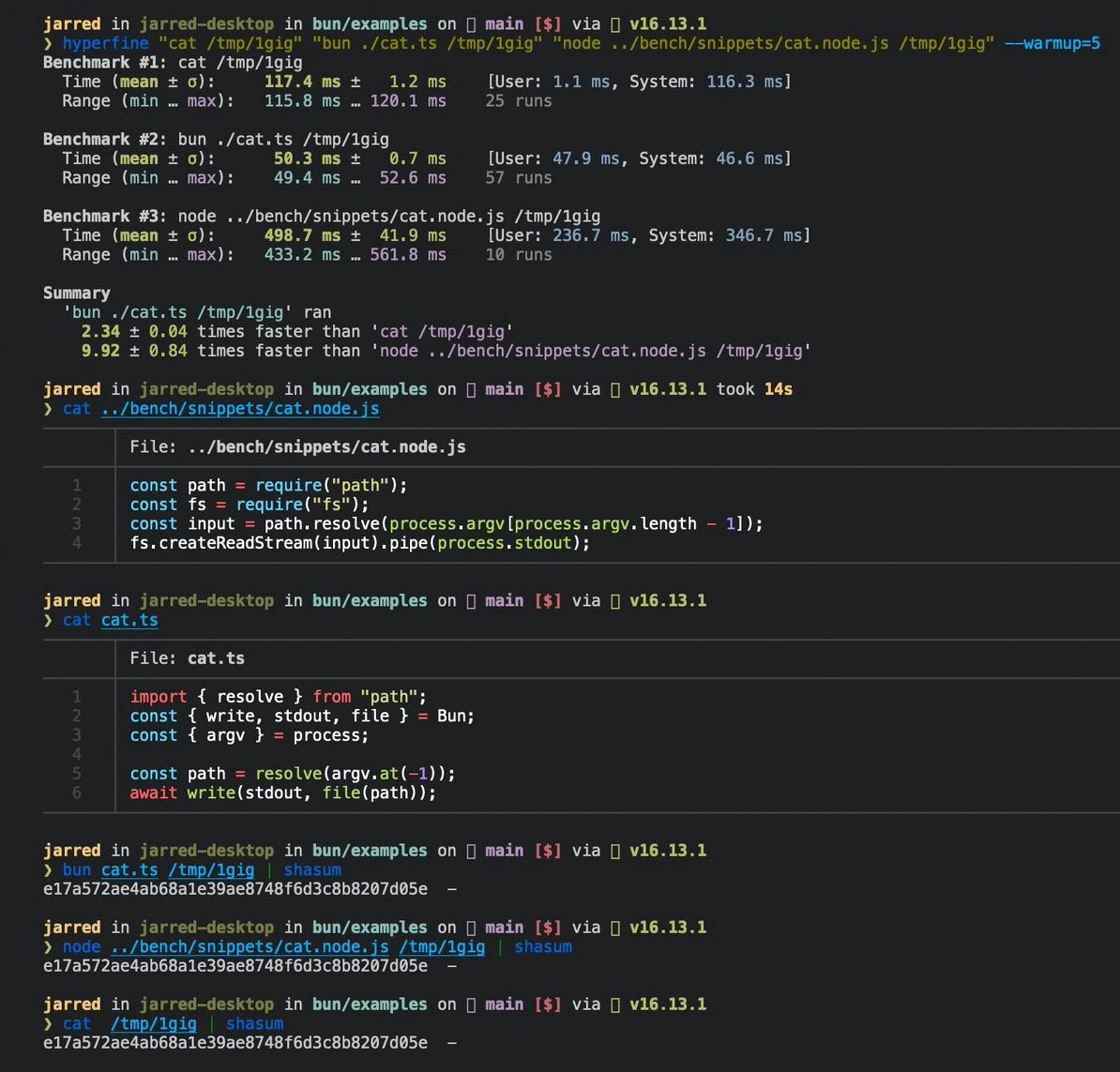
以下是 Linux 下 `cat` 命令的三行实现。
```ts cat.ts icon="https://mintcdn.com/bun-zhcndoc/cnUTwgMuf4cCrwC-/icons/typescript.svg?fit=max&auto=format&n=cnUTwgMuf4cCrwC-&q=85&s=e7767043c9e885c34f2d6c8fe2a95217" theme={"theme":{"light":"github-light","dark":"dracula"}}
// 用法
// bun ./cat.ts ./path-to-file
import { resolve } from "path";
const path = resolve(process.argv.at(-1));
await Bun.write(Bun.stdout, Bun.file(path));
```
运行该文件:
```bash terminal icon="terminal" theme={"theme":{"light":"github-light","dark":"dracula"}}
bun ./cat.ts ./path-to-file
```
在 Linux 上处理大文件时,速度是 GNU `cat` 的 2 倍。
 ***
## 参考
```ts theme={"theme":{"light":"github-light","dark":"dracula"}}
interface Bun {
stdin: BunFile;
stdout: BunFile;
stderr: BunFile;
file(path: string | number | URL, options?: { type?: string }): BunFile;
write(
destination: string | number | BunFile | URL,
input: string | Blob | ArrayBuffer | SharedArrayBuffer | TypedArray | Response,
): Promise;
}
interface BunFile {
readonly size: number;
readonly type: string;
text(): Promise;
stream(): ReadableStream;
arrayBuffer(): Promise;
json(): Promise;
writer(params: { highWaterMark?: number }): FileSink;
exists(): Promise;
}
export interface FileSink {
write(chunk: string | ArrayBufferView | ArrayBuffer | SharedArrayBuffer): number;
flush(): number | Promise;
end(error?: Error): number | Promise;
start(options?: { highWaterMark?: number }): void;
ref(): void;
unref(): void;
}
```
***
## 参考
```ts theme={"theme":{"light":"github-light","dark":"dracula"}}
interface Bun {
stdin: BunFile;
stdout: BunFile;
stderr: BunFile;
file(path: string | number | URL, options?: { type?: string }): BunFile;
write(
destination: string | number | BunFile | URL,
input: string | Blob | ArrayBuffer | SharedArrayBuffer | TypedArray | Response,
): Promise;
}
interface BunFile {
readonly size: number;
readonly type: string;
text(): Promise;
stream(): ReadableStream;
arrayBuffer(): Promise;
json(): Promise;
writer(params: { highWaterMark?: number }): FileSink;
exists(): Promise;
}
export interface FileSink {
write(chunk: string | ArrayBufferView | ArrayBuffer | SharedArrayBuffer): number;
flush(): number | Promise;
end(error?: Error): number | Promise;
start(options?: { highWaterMark?: number }): void;
ref(): void;
unref(): void;
}
```